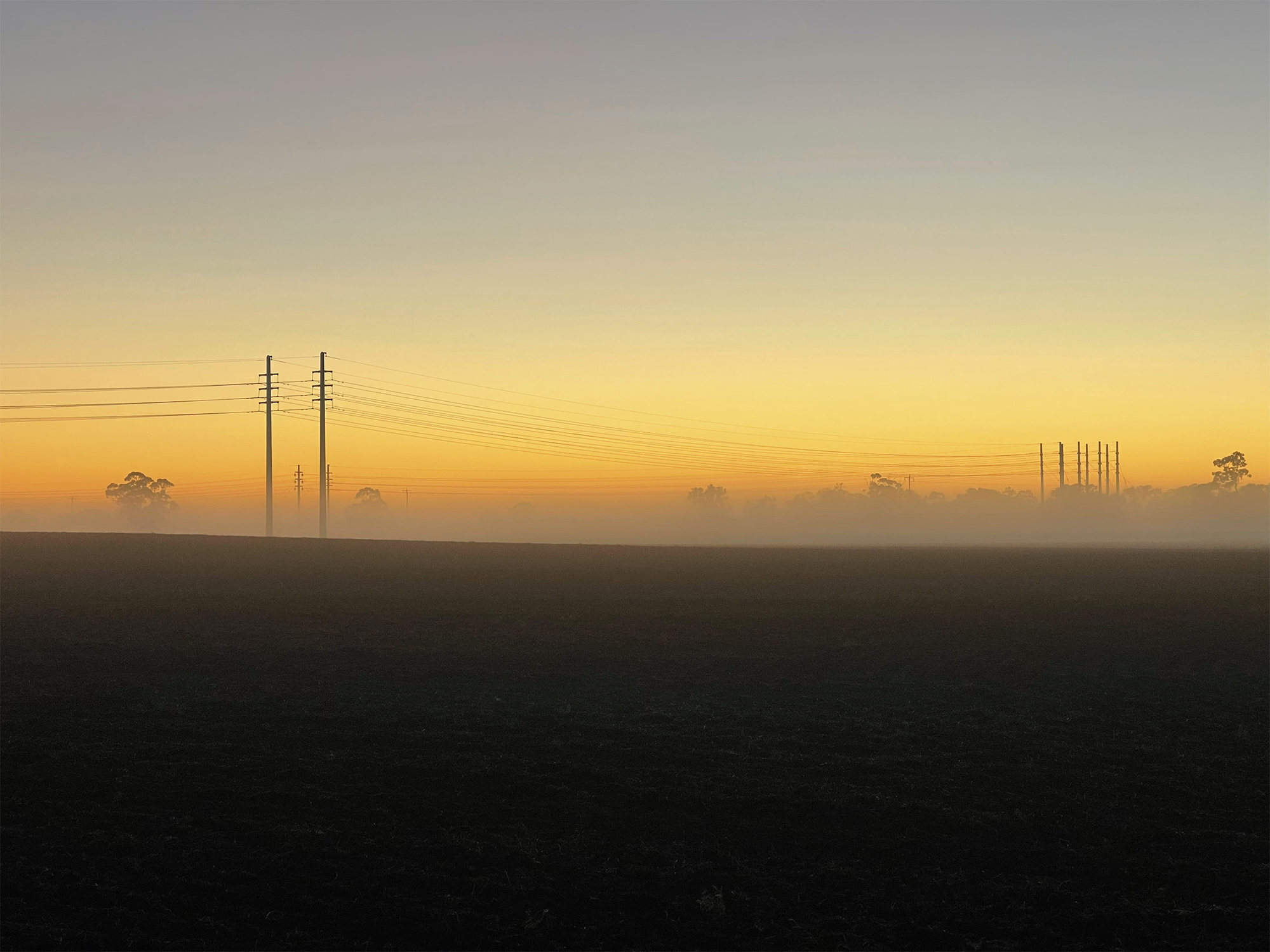
Most infrastructure gets built where it’s convenient. Roads connect existing towns. Pipelines follow established corridors. Buildings go up on flat, accessible land close to materials and labour. Energy infrastructure, particularly in Australia’s renewable buildout, rarely has that luxury.
The wind blows hardest on exposed ridgelines. The solar resource is richest in the inland desert. Pumped hydro sites exist where geography permits, in mountain country with the right elevation differential and water supply. The grid has to follow the energy, not the other way around. And that means building transmission infrastructure in conditions that would give most civil engineers pause.
Not All Sites Are Equal
Australia’s geography makes it one of the most demanding environments in the world for outdoor infrastructure. All new overhead lines in Australia must comply with AS/NZS 7000:2016 Overhead Line Design, which sets out structural, electrical, and safety requirements covering acceptable pole materials, load calculations for different wind regions and terrain categories, and additional factors like bushfire and cyclonic conditions. That standard exists because Australia’s environments are genuinely extreme and genuinely varied.
Wind speeds under AS/NZS 1170.2 vary dramatically from 146km/h in Region A to 317km/h in cyclonic Region D. Tropical cyclone and thunderstorm gust wind speeds dominate the extreme end of the spectrum, and the standard requires that terrain category assessments in cyclonic regions account for the fact that vegetation cannot be relied upon to provide wind shielding during a major wind event — it may not be there when the storm hits. A pole designed for a sheltered rural environment and a pole designed for a coastal cyclonic zone are, in engineering terms, entirely different structures, even if they look similar from the road.
Remote and inaccessible
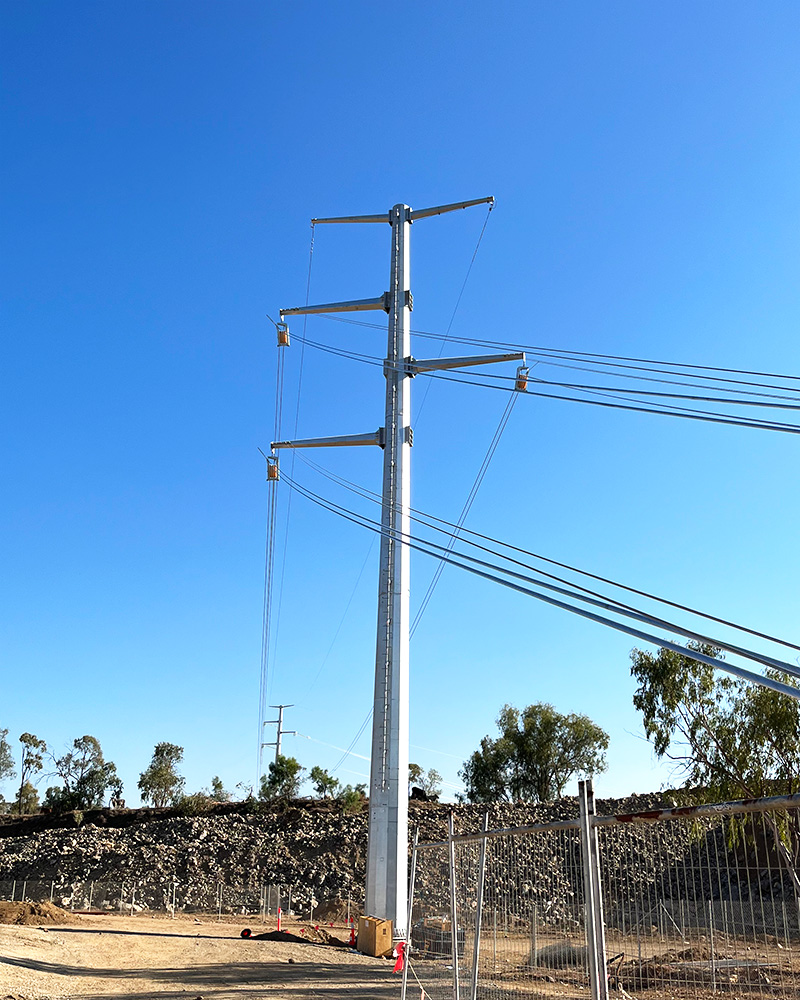
The engineering challenge in remote environments is different in character but equally demanding. The Kidston Pumped Storage Hydro project sits in Far North Queensland, in the ranges west of Cairns, in country that was once an operating gold mine. It is not, by any measure, an easy place to build. Access roads, crane pads, and laydown areas have to be established before structural work can begin. Supply chains stretch over long distances. Every component that arrives on site has been manufactured, tested, and transported before a single bolt is turned in the field. Errors or omissions discovered on site are expensive, because the fix is a long way away.
IUP supplied 275kV base plate mounted poles for the Kidston project, engineered to the specific load cases and site conditions of a remote high-voltage transmission connection in cyclone-adjacent terrain. The base plate mounting approach has particular advantages in rocky or difficult ground conditions where in-ground installation would require extensive rock anchoring or blasting. The structure arrives on site ready to bolt to a prepared foundation, which simplifies installation in locations where heavy earth-moving equipment is difficult to mobilise.
Wind-exposed agricultural country
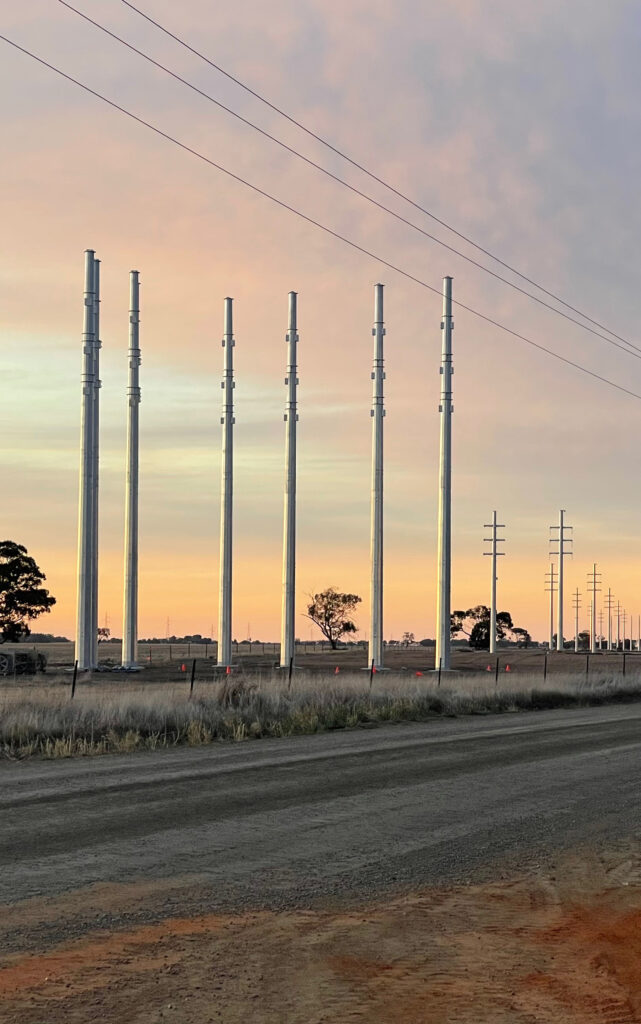
The Rye Park and Murra Warra wind farm projects presented a different set of challenges. Both are sited in exposed rural landscapes where wind loading governs the structural design — not cyclonic wind, but the sustained high winds of ridgeline and open plain environments that drive the turbines and, in turn, drive the load calculations for every pole and structure on the site.
The Rye Park Wind Farm in southern NSW, with 66 turbines offsetting approximately 960,000 tonnes of CO2 per year, and Murra Warra II near Horsham in Victoria’s Western District, one of Australia’s largest wind farms, both required transmission infrastructure engineered to perform in conditions that would accelerate the degradation of less robust materials. Steel’s consistent structural properties and its resistance to the kind of fatigue loading that wind-exposed structures accumulate over decades make it the practical choice for these environments.
Tropical and cyclonic: a different kind of harsh
Espiritu Santo, the largest island in Vanuatu, sits in the South Pacific cyclone belt. It is a lush, tropical environment with high humidity, significant rainfall, and the periodic passage of cyclonic weather systems that the Bureau of Meteorology monitors across the Australian region and surrounding Pacific. It is also a place where electricity, for many communities, has historically been unavailable entirely. IRENA’s Renewables Readiness Assessment for Vanuatu identified the integration of renewables into existing power infrastructure as a central challenge for the country’s energy future — a challenge that depends, in part, on the quality and durability of the physical structures that carry the power.
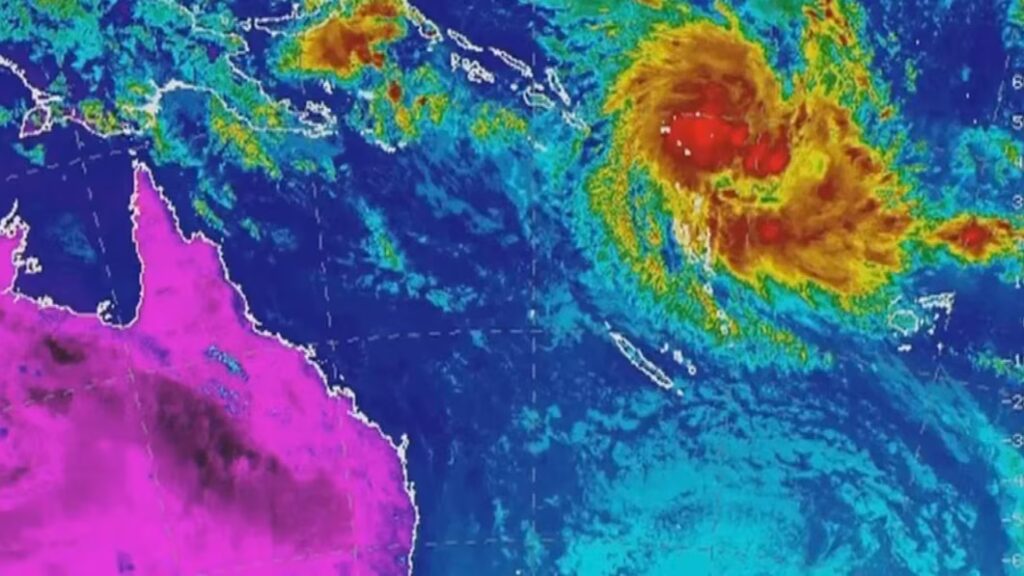
Above: Tropical Cyclone Lola bearing down on Vanuatu. (Supplied: Japan Meteorological Agency)
Since 2016, IUP has supplied in-ground mounted poles to Vanuatu Utilities and Infrastructure (VUI) as part of the annual network expansions that have brought electricity to communities on Espiritu Santo for the first time. The island now generates most of its electricity from renewable sources, integrating hydro generation from the Sarakata River with diesel backup in Luganville. The poles IUP supplied have been operating in a tropical coastal environment through multiple cyclone seasons — a sustained real-world test of the engineering specification’s adequacy.
The material choice for a project like Vanuatu reflects a different set of constraints from a high-voltage Australian transmission project, but the underlying engineering logic is the same. The structure has to outlast the weather it will encounter, in an environment where replacement is difficult and failure is consequential.
Why specification matters more than it appears
The tendency in infrastructure procurement is to treat poles and structures as a commodity — an undifferentiated line item that can be value-engineered without consequence. In standard environments with straightforward load cases, that assumption might hold. In remote and harsh environments, it does not.
AS/NZS 7000:2016 requires that terrain category assessments account for the specific exposure of the installation site — the surrounding terrain, its permanence, and its effect on wind loading on the pole and its equipment. A structure that hasn’t been engineered to the specific terrain category, wind region, and corrosion classification of its site will not perform as expected over its design life. In a remote environment, the cost of that underperformance — early replacement, unplanned maintenance, network unreliability — is multiplied by the difficulty of access.
The right specification, developed from site-specific load data and environmental assessment, is what separates infrastructure that lasts from infrastructure that doesn’t. In the environments where Australia’s renewable energy is being built, that distinction is not academic.
Working on a project in a remote or demanding environment? IUP engineers and manufactures steel utility poles and substation structures for Australia’s most challenging energy infrastructure sites. Contact the IUP team to discuss your project requirements.