Every announcement about Australia’s energy transition comes with the same imagery. Wind turbines turning against a blue sky. Solar panels spreading to the horizon. A politician in a hard hat at a sod-turning ceremony. The generation story is photogenic, and it gets told.
The infrastructure that makes any of it usable is harder to photograph and rarely makes the evening news. But without it, the turbines and the solar arrays are just expensive sculptures in a paddock.
Every electron generated by every renewable project in Australia has to pass through a substation before it reaches anyone. That fact tends to get lost in the conversation about the energy transition. It probably shouldn’t.
What substations do
A substation is the node where electricity is converted, controlled, and directed. Generation assets produce power at relatively low voltages; substations step that voltage up for long-distance transmission across high-voltage lines. At the other end of the journey, a substation steps it back down for distribution to end users. In between, substations manage load flows, protect the network from faults, and provide the switching infrastructure that keeps the grid stable when generation or demand shifts unexpectedly.
AEMO’s 2024 Integrated System Plan describes a national grid that will need to triple its generation and storage capacity by 2050. Every new renewable energy zone, every new interconnector, and every new stretch of high-voltage transmission line requires new or upgraded substations at each end. The substation is not optional infrastructure. It is the point at which the energy transition either connects or stalls.
The scale of the current buildout makes this concrete. Transgrid’s Dinawan substation in the NSW Riverina, completed in late 2025, sits at the junction of a 375-kilometre 330kV transmission line from Buronga and a 160-kilometre 500kV line from Wagga Wagga, forming a key connection point for new solar and wind generation from the South West Renewable Energy Zone. In Western Australia, construction is underway on the Clean Energy Link North project, a 354-kilometre corridor of new transmission infrastructure including terminals and substations that will double capacity in sections of the South West Interconnected System. These are not incremental upgrades. They are the physical infrastructure of a new energy economy, and substations are at the centre of each one. You just don’t tend to see them on the front page.
The structures inside
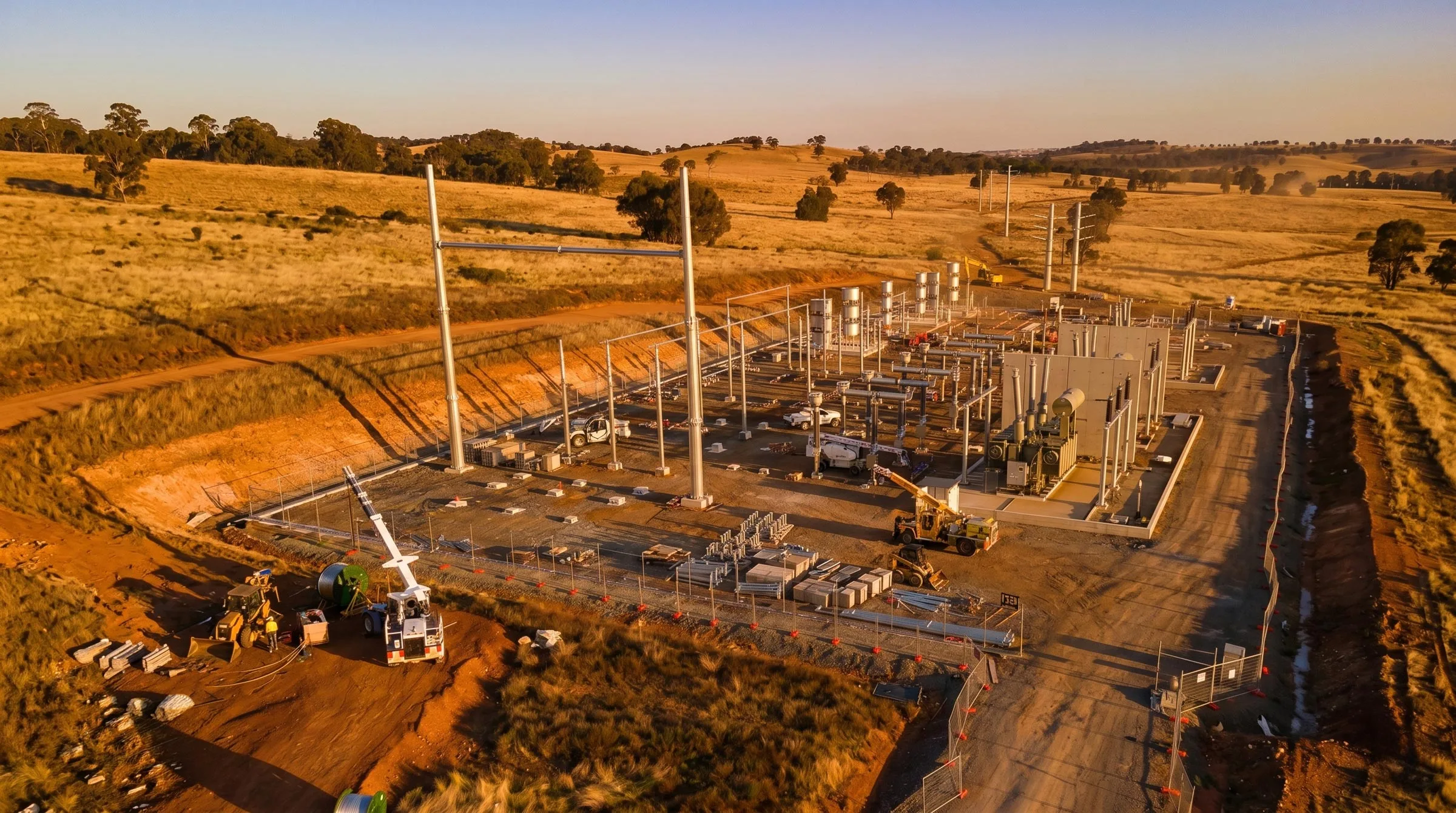
What most people picture when they think of a substation – the fenced compound of transformers and switchgear visible from the highway – is only part of the story. The structural framework that organises and supports all of that equipment is equally critical, and the least discussed part of an already under-discussed piece of infrastructure.
Gantries are the overhead frameworks that carry high-voltage conductors across the substation yard, routing power between incoming lines, transformers, and outgoing feeders. In a modern renewable energy substation, these structures must manage significant conductor loads across varying spans, often in environments with high wind exposure, cyclonic risk, or corrosive coastal or industrial atmospheres. Custom tubular steel gantries have become the preferred solution for many new projects because they can be precisely engineered to suit each site’s load cases, and they offer installation advantages over traditional lattice designs, reducing construction time without compromising structural performance.
Equipment support structures carry the substation’s electrical components at the correct height and orientation: post insulators, current transformers, voltage transformers, high-voltage switchgear, busbars, and surge arrestors, among others. Each component has precise clearance requirements from adjacent structures and conductors, and the support structures must maintain those clearances under the full range of mechanical and thermal loads the site will experience across a multi-decade service life.
Lightning poles provide shielding for the substation yard, intercepting direct strikes before they reach sensitive electrical equipment below. The design of an effective shielding system depends on pole height, placement, and the geometry of the equipment being protected – all of which vary with each substation layout.
Light poles address the particular challenge of providing reliable illumination in a high-voltage environment where conventional maintenance approaches introduce unacceptable safety risks, a subject explored in more detail in an earlier post on this site.
These structures form the physical fabric of the substation. They are not the headline equipment. They are what everything else is built around, and they almost never appear in a press release.
Why custom engineering matters
Substations built for renewable energy projects present engineering challenges that differ from those of conventional grid infrastructure. Many are located in remote areas with limited access for heavy construction equipment. They often operate at high voltages – 330kV or 500kV – where the mechanical loads on structural frameworks are substantially greater than those at distribution level. And they are increasingly being built to compressed timelines, driven by project finance schedules and the urgent pace of the energy transition.
Off-the-shelf structural solutions rarely fit these parameters cleanly. The most effective approach is to engineer each structure to the specific load cases of the project, beginning with the line design data and working outward to the geometry and specification of every gantry, support frame, and pole on the site.
IUP has supplied substation structures across a range of renewable and clean energy projects in Australia. At the Euroa Substation in Gladstone, Queensland – part of Fortescue’s hydrogen electrolyser facility – IUP supplied 275kV base plate mounted pipe gantries. At the nearby Aldoga Solar Farm Substation, where 33kV AC from the inverters is stepped up to 275kV for output into Powerlink’s transmission network, IUP supplied the full scope of substation structures: gantries, equipment support structures, lightning poles, and light poles.
The foundation nobody photographs
The renewable transition is usually measured in generation capacity: gigawatts installed, percentage of renewables in the mix, the record output of a good wind week. The infrastructure that makes any of that usable – the substations, the gantries, the support structures that organise high-voltage electricity into something the grid can manage – tends not to feature in that accounting.
That is not a reason to underestimate it. The Australian Energy Infrastructure Commissioner has consistently identified infrastructure delivery pace as the binding constraint on the transition, not generation ambition. Every substation that comes online on time and on spec is a step toward a grid that can carry the energy Australia is working so hard to produce.
The turbines and the solar panels get the photographs. The structures that connect them to the rest of the country get the job done.
Working on a substation project? IUP designs and manufactures custom tubular gantries, equipment support structures, lightning poles, and light poles for electrical substations across Australia. Contact the IUP team to discuss your project requirements.