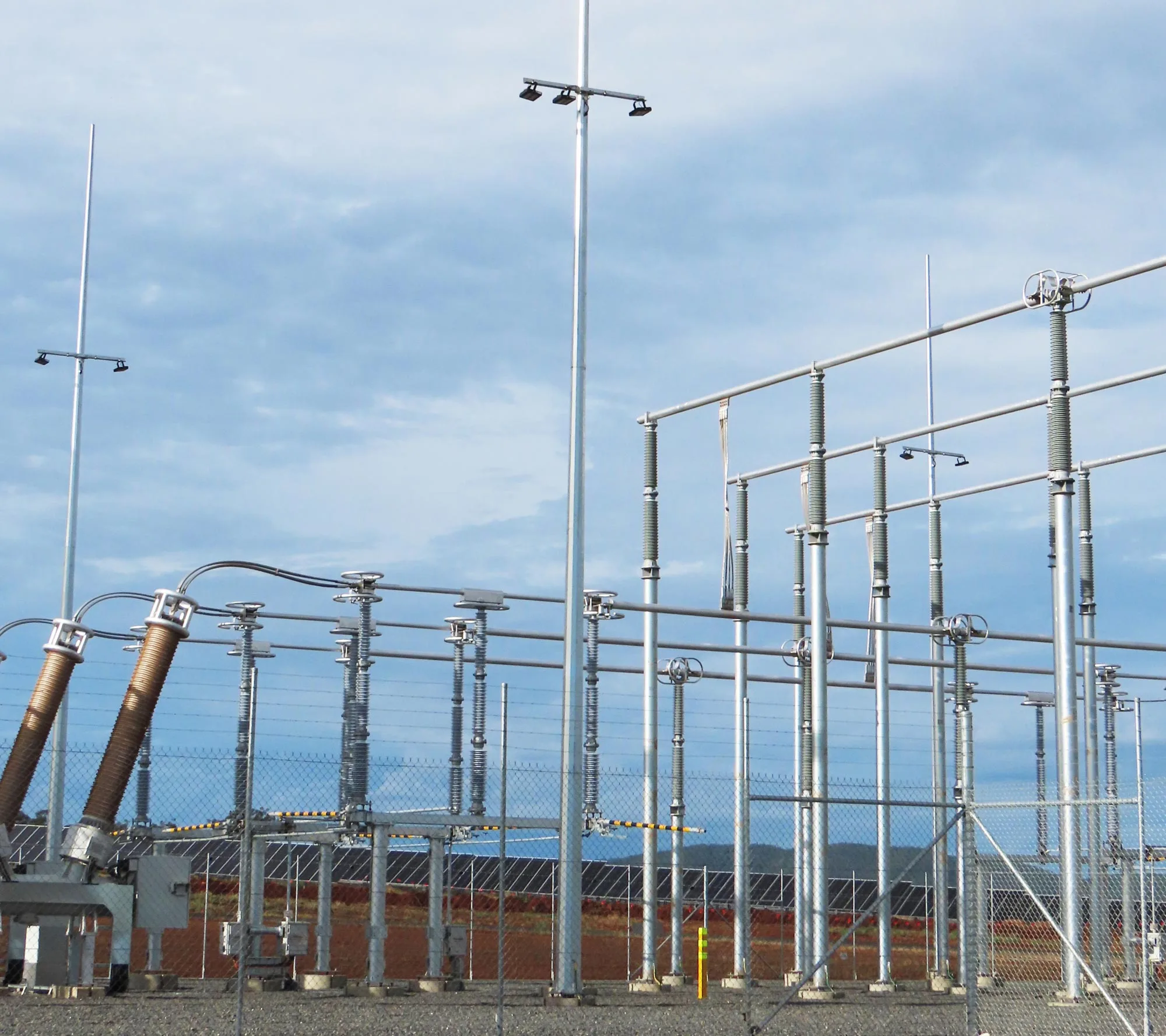
As the Australian grid rapidly expands, the construction and upgrading of electrical substations present complex safety challenges. Within these high-voltage environments, providing reliable illumination is an operational necessity, but the structures supporting these luminaires must not introduce new risks to the site.
For electrical engineers and asset managers, the specification of a light pole is fundamentally an exercise in safety engineering. It requires balancing extreme structural resilience against the very real human hazards of conducting maintenance within a live switchyard.
How Do Mid-Hinged Light Poles Engineer Out Maintenance Hazards?
In a standard commercial environment, maintaining a luminaire typically involves an Elevated Work Platform (EWP) or scaffolding. In a high-voltage substation, deploying heavy machinery near live overhead conductors introduces critical safety risks, including arc flashes and equipment strikes.
According to Safe Work Australia regulations regarding work in the vicinity of overhead electric lines, eliminating the hazard entirely is always the preferred engineering control. This is where mid-hinged light poles become a vital safety asset.
Engineered with a precision pivot mechanism, these poles allow a single operator to safely lower the upper section of the column to ground level. By completely removing the need for EWPs and working at heights, the mid-hinged design engineers out the primary risk of luminaire maintenance, ensuring that routine upkeep does not require dangerous proximity to high-voltage equipment or costly network outages.
What Are the Structural Safety Requirements for Extreme Weather?
Operational safety must be matched by structural survivability. Substations are critical permanent assets, and their internal structures must withstand severe environmental loads without deflecting into electrical clearances or failing catastrophically.
The structural safety of a light pole is governed by strict wind load calculations outlined in AS/NZS 1170.2 (Structural design actions – Wind actions). As documented by Geoscience Australia, regional wind multipliers dictate the immense aerodynamic drag that these vertical structures must endure, particularly in cyclonic regions.
To manage these dynamic loads safely, engineers utilise tapered octagonal steel columns secured via base plate mounted foundations. This engineered geometry minimises wind resistance and reduces structural fatigue at the base, ensuring the pole remains rigid and compliant under the most extreme Australian weather events.
How Does Material Selection Prevent Ground-Line Safety Failures?
A structurally compliant design is only safe if it maintains its integrity over a multi-decade lifecycle. In a switchyard, the catastrophic failure of a rusted lighting column presents an immediate threat to both personnel and the continuity of the power grid.
The base plate and the mid-hinge mechanism are the most structurally critical points of the pole, and they are also the most exposed to atmospheric moisture, soil acidity, and potential pooling water. To engineer out the risk of corrosion-induced failure, these structures must be protected in accordance with AS/NZS 4680 (Hot-dip galvanised coatings).
The Galvanizers Association of Australia (GAA) highlights that hot-dip galvanising creates a metallurgical bond that provides sacrificial cathodic protection. This ensures that vital moving parts, shear bolts, and base plate connections do not seize or degrade, guaranteeing the physical safety of the asset for its full 50-year design life.
The IUP Engineering Verdict
The illumination of high-voltage infrastructure leaves no room for structural compromise. The structures deployed in these zones must actively contribute to the safety protocols of the site—protecting maintenance crews from electrical hazards while possessing the sheer strength to survive extreme environmental stress.
Our light pole structures are engineered to illuminate electrical substations safely and effectively. They are available in both fixed and mid-hinged configurations, ensuring the most suitable lighting structure to support your project. By matching robust, galvanised steel engineering with intelligent mechanical design, we provide the ultimate structural assurance for Australia’s most critical energy networks.
Looking for Technical Data?
- Access the IUP Technical Resources for our full suite of pole assembly and installation guides.
- View our specifications for Light Poles, engineered for Australian electrical infrastructure standards.
Request a Custom Structural Analysis If you are specifying for a new substation build or a network upgrade, our engineering team can provide full structural verification and compliance documentation for your lighting columns.